Navigating the Product Journey: MVP vs. MMP vs. MLP
Startup
Why moving too fast can cost you more than you think

Why moving too fast can cost you more than you think
In the product-world, three acronyms regularly get tossed around: Minimum Viable Product (MVP), Minimum Marketable Product (MMP), and Minimum Lovable Product (MLP). They sound similar, but each serves a distinct purpose and skipping any of them means you risk building the wrong thing, too fast, or missing real traction.
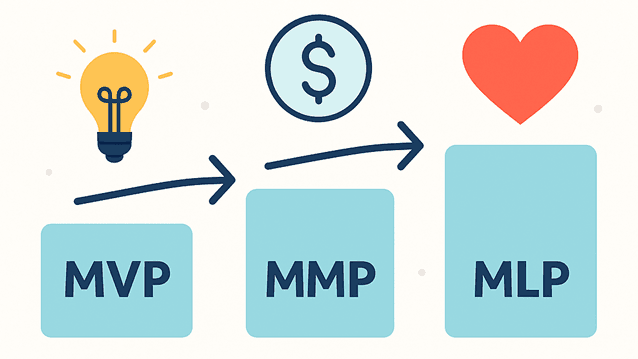
An early adopter version of your product that has just enough features to enable a build-measure-learn cycle. It involves learning, quickly iterating, and verifying assumptions (Ries, 2015). Your objective at this stage is to verify the problem-solution fit, identify the important factors, and refrain from constructing a full-scale project before you are ready.
The MMP is the version you release to the market to begin creating value and income once you've confirmed important hypotheses. It has the bare minimum of qualities to justify marketing and purchase. Launching a product that answers a real problem, not merely a test. Your objective here is to launch a product that people will buy.
The goal of this step is to make users adore your product rather than merely putting up with it. It entails emphasizing brand, experience, and emotional ties. They will serve as your brand ambassadors to promote your goods. Your objective at this stage is to increase user loyalty and referrals while differentiating based on experience rather than just functionality.
Jumping from idea straight to MMP means you might build features nobody wants, waste money, risk poor uptake. Without an MVP you lack validated learning. And you risk high development costs, low market fit, massive waste.
Building a lovable version without first ensuring market viability is like producing a luxury car before knowing if anyone will buy it. Great product, terrible revenue. You delight maybe ten users: too late.
Skipping means skipping key learning loops. Your timeline shrinks but your risk skyrockets.
Development driven by hypotheses (HDD): Give hypotheses a problem, user, and value definition.
Determine the bare minimum of features needed to test the hypothesis; launch your product to early adopters; get qualitative and quantitative input; and check as to whether users were involved. Have they come back? Did value show up?
Define pricing, sales channel, and positioning; add features that facilitate revenue, scale, and market preparedness; launch to a larger market; and track monthly recurring revenue (MRR), annual recurring revenue (ARR), Customer Acquisition Cost (CAC), and customer churn (the rate at which customers cancel their subscriptions).
Measure Net Promoter Score (NPS), user-generated content, and organic growth; improve user experience: UX, performance, and brand feel; provide features that thrill rather than just address problems; and promote referrals, loyalty, and aim to reduce customer churn.
Products aren’t built once; they evolve. Respect the sequence: learn, launch, love.
When you skip stages, you skip learning. And when you skip learning, you gamble about your product’s future.
Start with MVP. Prove it. Then build your MMP. Scale it. Then enchant it into MLP.
Ash Maurya (2016). Scaling lean: mastering the key metrics for startup growth. New York: Portfolio/Penguin.
Banfield, R., C. Todd Lombardo and Wax, T. (2015). Design Sprint. ‘O’Reilly Media, Inc.’
Blank, S.G. (2013). The four steps to the epiphany: successful strategies for products that win. S.L.: K & S Ranch.
Cagan, M. (2018). Inspired: How to create tech products customers love. Hoboken: Wiley.
Huryn, P. (2023). What is a Minimum Viable Product? Everything You Need to Know. MVP vs. MMP vs. MLP. [online] Productcompass.pm. Available at: https://www.productcompass.pm/p/mvp-everything-you-need-to-know-mvp
Raj, N. (2024). Minimum Viable Product (MVP) - What is it & how to start. [online] Atlassian. Available at: https://www.atlassian.com/agile/product-management/minimum-viable-product
Ries, E. (2011). The Lean startup: How today’s Entrepreneurs Use Continuous Innovation to Create Radically Successful Businesses. New York: Crown Publishing Group.
Ries, E. (2015). What Is an MVP? Eric Ries Explains. [online] Lean Startup Co. Available at: https://leanstartup.co/resources/articles/what-is-an-mvp/
Shopify. (2023). Lean Startup Model: Key Principles and Stages. [online] Available at: https://www.shopify.com/blog/lean-startup-model